
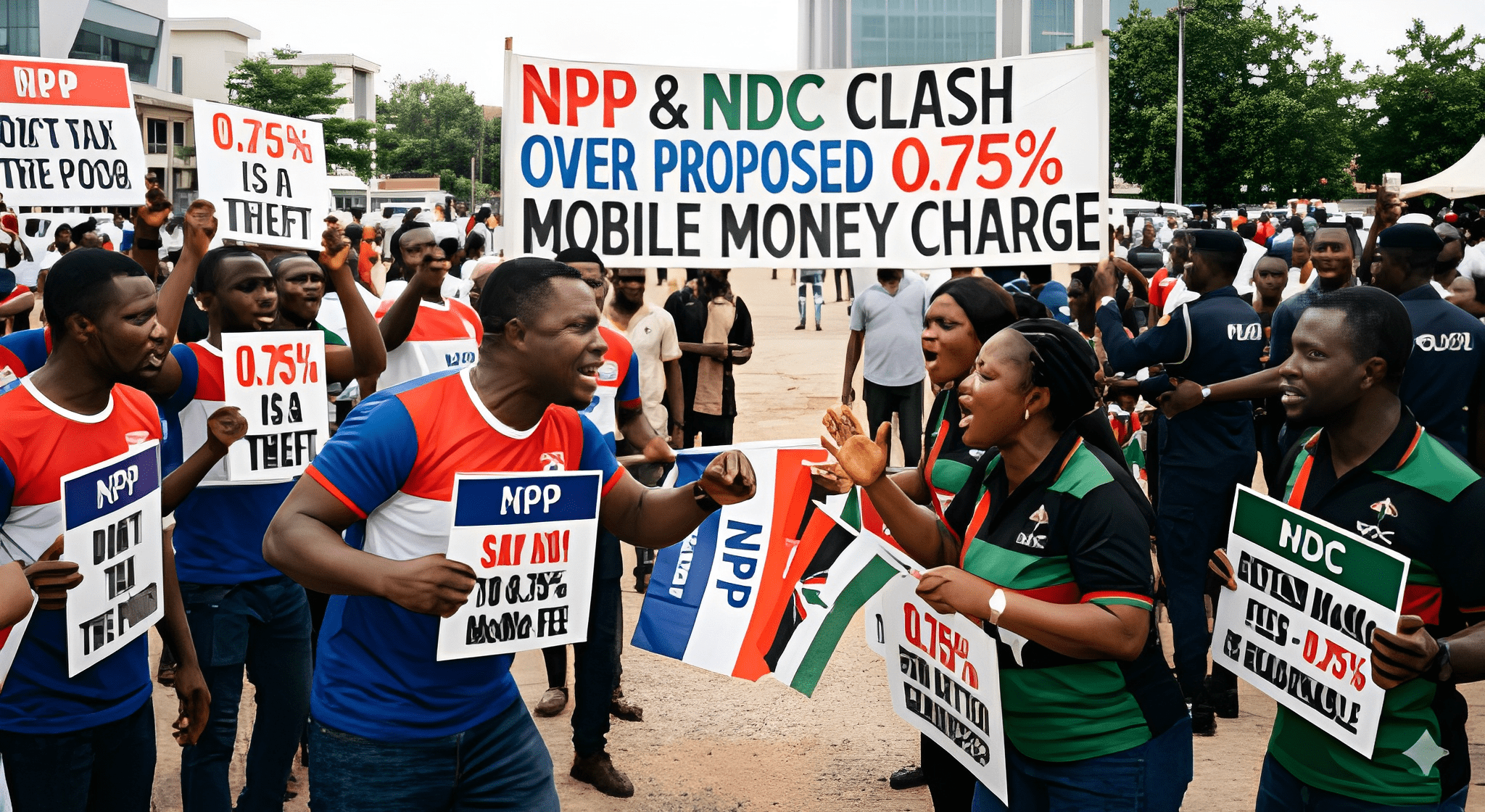
ACCRA, GHANA — Ghana’s parliament witnessed chaotic scenes as the New Patriotic Party (NPP) Minority and the National Democratic Congress (NDC) Majority clashed over a newly proposed 0.75% fee on wallet-to-bank mobile money transfers.
The fierce political stand-off prompted First Deputy Speaker Bernard Ahiafor to order portions of the heated exchanges expunged from the official parliamentary records.
The dispute erupted following an announcement by Mobile Money Fintech Limited (MMFL)—MTN Ghana’s newly structural fintech unit—that it planned to introduce a 0.75% charge on direct mobile money-to-bank transactions beginning June 1, 2026. Under the proposed tier, charges would have been capped at GH¢5 per transaction.
The Battle Lines in Parliament
The NPP Minority Caucus immediately went on the offensive, labeling the proposed fee as a hidden attempt to revive the controversial Electronic Transfer Levy (E-Levy). NPP Minority Leader Alexander Afenyo-Markin addressed the media and slammed the NDC administration, demanding that Finance Minister Dr. Cassiel Ato Forson appear before the house.
“The government is attempting to reintroduce the E-Levy through the back door. This places immense, unfair pressure on digital financial transactions and ordinary traders,” Afenyo-Markin argued. “We demand full disclosure and urgent accountability on this matter.”
The NDC Majority fiercely rejected the accusation of hypocrisy. Government officials defended the planned fee, clarifying that it was not a state tax but a transactional operational cost.
| Position | Arguments Presented |
|---|---|
| NPP Minority | • Claims it is an “E-Levy in disguise” designed to overtax consumers. • Warns it will discourage mobile money usage and hurt small business traders. • Demands the Finance Minister face parliamentary scrutiny. |
| NDC Majority | • Clarifies it is a standard commercial service fee, not a government tax. • Linked directly to interoperability and technical processing costs. • Accuses the NPP of playing political games with private sector pricing. |
Central Bank Intervenes
As public backlash and political tensions threatened to boil over, the Bank of Ghana (BoG) stepped in to halt the implementation. The central bank directed MMFL to suspend the June 1 rollout to allow for broader stakeholder consultations.
In an official statement, the Bank of Ghana emphasized that the suspension is intended to safeguard consumer protection and ensure that any future revisions to mobile financial service charges are introduced fairly.
Mobile money remains a critical pillar of the Ghanaian economy, with transaction values heavily scaling up over recent years. While the central bank’s freeze has temporarily cooled the immediate baseline layout of the fee, the underlying political clash ensures that digital finance pricing will remain a key battleground between the NPP and NDC
About The Author